Pepper Identifier
What type of pepper is this? Find out from the pod, the plant or both.
Tap what you see. Each answer trims 5,195 WikiPepper varieties down to the ones that fit.
What can you look at?
Pick one. You can switch any time, and your answers carry over.
What the pepper identifier does
The WikiPepper Pepper Identifier names a chili pepper from what you see, not from a photo. Pod answers match 5,195 WikiPepper varieties as of October 11, 2026. Plant answers weigh the clues Barboza and colleagues use to separate the five cultivated species in their 2022 Capsicum monograph.
How do you identify a pepper plant?
Name the species first, then the variety. On a ripe pod, look where the cap (the calyx) meets the stem. Barboza and colleagues’ 2022 Capsicum monograph names a ring there the most consistent single trait of C. chinense, though some chinense plants lack it. Teeth you can see on the cap point to C. baccatum or C. pubescens. Then match the pod’s shape, ripe color and length against the varieties of that species.
Five checks, in order
- The cap ring. Look at a ripe pod from the side. A ring between the cap and the stem is a strong sign of C. chinense. The IPGRI pepper descriptors say to judge it on ripe pods, not flowers or young pods. Genebank evaluators found no ring on about a quarter of chinense accessions, so a missing ring rules nothing out.
- The cap teeth. Look at the cap. Teeth you can see just below the rim point to C. baccatum or C. pubescens. A smooth cap, or tiny bumps of 0.5 mm or less, fits C. annuum, C. chinense or C. frutescens.
- The flower. If the cap has teeth, flower color splits the two toothed species: purple means C. pubescens, white with greenish-yellow spots means C. baccatum. Among cultivated peppers, yellow pollen tips strongly suggest C. baccatum. Blue or purple pollen tips fit the other four.
- The seeds. Cut open a ripe pod. Among cultivated peppers, black seeds mean C. pubescens. Some wild species have dark seeds too. In any other pepper, dark seeds point to mold or cold damage. Do not eat a pod with mold inside.
- Flowers per joint. Count the flowers at each joint on the stem. C. chinense usually carries 2 to 4, and C. annuum usually carries 1. C. frutescens also carries 2 to 4, so treat this as a weak clue.
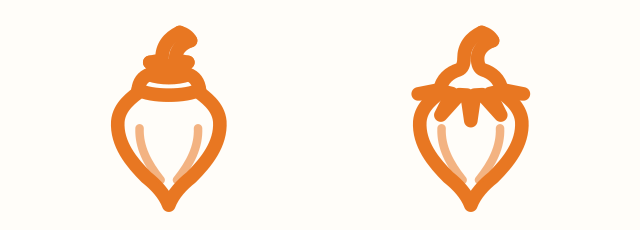
Pepper identification chart
The clues that separate the five cultivated Capsicum species, from Barboza et al. 2022 and the sources below. A blank cell means the chart makes no claim.
| Clue | C. annuum | C. chinense | C. frutescens | C. baccatum | C. pubescens |
|---|---|---|---|---|---|
| Ring at the cap, ripe pod | Usually; missing on some | No ring; cup-shaped cap | |||
| Cap teeth | None, or tiny bumps 0.3 to 0.5 mm | None, or tiny bumps | None, or about 0.5 mm | Visible, 0.9 to 2.5 mm on the flower; lie flat on the pod | Visible, 0.5 to 1.5 mm on the flower; stand out from the pod |
| Flower color | White, rarely purple | Dull white or greenish-white | Dull white or greenish-white | White with greenish-yellow spots | Purple |
| Pollen tips (anthers) | Pale blue to purple, very rarely yellow | Blue, bluish-gray or purple, very rarely yellow | Bluish-gray or purplish, rarely yellow | Yellow | Purple with a wide cream stripe |
| Flowers per joint | Usually 1, sometimes 2 | Usually 2 to 4, sometimes 5 | 2 to 4, sometimes 5 | 1 to 3 | 1 to 2, rarely 4 |
| Seeds | Pale | Pale | Pale | Pale | Brownish-black to black, about 5.5 to 7 mm |
| Young leaves | Fuzzy and wrinkled | ||||
| Varieties on WikiPepper | 2,271 | 2,105 | 159 | 321 | 196 |
Variety counts as of October 11, 2026. A cross counts under both parents.
Example peppers by species
- C. annuum: Jalapeño, Cayenne, Poblano, Chiltepín, Bird's Eye
- C. chinense: Habanero, Scotch Bonnet, Ghost Pepper, Carolina Reaper, Fatalii
- C. frutescens: Tabasco, Malagueta, Siling Labuyo, Piri Piri
- C. baccatum: Aji Amarillo, Aji Lemon Drop, Bishop's Crown, Dedo de Moca
- C. pubescens: Rocoto, Rocoto Canario, Mini Rocoto, Olive Rocoto
- Wild species: Cumari, C. galapagoense, PI 260427, PI 594141
Questions
What type of pepper is this?
Find the species first. The cap, the flower and the seeds separate the five cultivated species. Color alone rarely does: most WikiPepper varieties start green and most ripen red. Then the pod’s shape, ripe color and length narrow the variety. The WikiPepper Pepper Identifier asks these questions one at a time and narrows 5,195 varieties to the ones that fit.
Is there an app or website that identifies peppers?
The WikiPepper Pepper Identifier runs free in any web browser, with nothing to install. It does not read photos. You answer one question at a time about the pod, the plant or both, and it narrows 5,195 varieties to the ones that fit.
How can I identify different types of chili peppers?
Sort them by species first. Five species hold the cultivated chili peppers: C. annuum, C. chinense, C. frutescens, C. baccatum and C. pubescens. The cap, the flowers and the seeds separate them. Pod shape, color and size then narrow the variety.
How do you tell C. chinense from C. annuum?
Look at a ripe pod where the cap meets the stem. C. chinense usually shows a ring there. Some chinense plants lack it, so count flowers too: chinense usually carries 2 to 4 at each joint, annuum usually 1. C. frutescens also carries 2 to 4 but has no ring. Pollen tip color does not separate them.
Does a missing ring mean C. annuum?
No. C. frutescens has no ring either, and genebank evaluators found no ring on about a quarter of C. chinense accessions. Check the cap teeth, the flower and the seeds before you settle on a species.
What pepper has black seeds?
Among cultivated peppers, only C. pubescens, the rocotos and manzanos, has black seeds. They are the largest in the genus, about 5.5 to 7 mm. The other four cultivated species have pale seeds. Some wild species have dark seeds too. In any other pepper, dark seeds point to mold or cold damage. Do not eat a pod with mold inside.
What pepper has purple flowers and black seeds?
Among cultivated peppers, C. pubescens, the rocotos and manzanos. Check the cap too: C. pubescens has teeth you can see on it. A few C. annuum plants have purple flowers, but their caps have no visible teeth and their seeds are pale. Fuzzy young leaves back up C. pubescens.
Does anther color tell you the species?
Only as a backup clue. Anthers are the pollen tips in the middle of the flower. Among cultivated peppers, yellow anthers strongly suggest C. baccatum. Blue or purple anthers fit C. annuum, C. chinense, C. frutescens and C. pubescens, so they do not pick between those four. An annuum without purple pigment can have yellow anthers, and most wild species have yellow or cream ones.
Which peppers have teeth on the cap?
Among cultivated peppers, C. baccatum and C. pubescens. Barboza and colleagues give their cap teeth as up to 2.5 mm long on the flower. C. annuum, C. chinense and C. frutescens have no teeth, or tiny bumps of 0.5 mm or less. Teeth do not tell baccatum from pubescens. Check flower color, seed color and young leaves.
Sources
- Barboza, G.E. et al. Monograph of wild and cultivated chili peppers (Capsicum L., Solanaceae). PhytoKeys 200, 2022.
- Brilhante, B.D.G.S. et al. Agronomy 11: 854, 2021 (calyx constriction in 69 accessions).
- IPGRI, AVRDC and CATIE. Descriptors for Capsicum, 1995.
- University of Georgia Extension. Common defects of bell peppers explained, Circular 1306, 2024.
- South Dakota State University Extension. Pepper internal rot.
The tool matches pod answers against 5,195 live WikiPepper records and scores plant answers by species traits from the sources above. See also the pepper plant anatomy guide and the flower guide.